Every push-up, squat, and plank uses the same resistance: your own body. Bodyweight exercises for beginners are the simplest way to start strength training — no gym, no equipment, no waiting. Just you and a bit of floor space.
But “simple” doesn’t mean “do it any old way.” Good form turns a basic move into an effective one; bad form turns it into an injury risk. This guide covers the best beginner bodyweight exercises, correct form for each, and a starter plan to follow.
Why Bodyweight Training Is Ideal for Beginners
Bodyweight training meets you exactly where you are. Unlike machines that lock you into fixed paths, these moves build balance, coordination, and control all at once — and they scale easily, so each exercise grows with you. Train anywhere: your living room, a park, a hotel room. When the workout fits your life this easily, excuses fade and the habit sticks.
If you have a health condition, check with a professional before starting a new exercise program.
The 8 Best Bodyweight Exercises for Beginners
1. Bodyweight Squat
The squat builds your quads, glutes, and core, and teaches the most useful movement pattern in fitness: controlled sitting and standing.
How to do it:
1. Stand with feet shoulder-width apart, toes slightly out
2. Push your hips back and bend your knees
3. Lower until thighs are roughly parallel to the floor
4. Keep your chest up and heels flat on the ground
5. Drive through your heels to stand
Make it easier: Squat to a chair — lower until you lightly touch the seat, then stand.
2. Incline Push-Up
Push-ups build your chest, shoulders, and triceps; the incline version lets you build strength with good form first.
How to do it:
1. Place hands on a sturdy elevated surface (table, bench, or stairs)
2. Step feet back into a straight line from head to heels
3. Lower your chest toward the surface with elbows at about 45 degrees
4. Push back up without letting your hips sag
Make it easier: Use a wall — stand at arm’s length and push against it.
3. Glute Bridge
This wakes up your glutes, which spend most of the day switched off in a chair. Strong glutes protect your lower back.
How to do it:
1. Lie on your back, knees bent, feet flat and hip-width apart
2. Press through your heels and lift your hips
3. Squeeze your glutes at the top for 2 seconds
4. Lower slowly without arching your lower back
Make it easier: Reduce the range of motion — lift only halfway up.
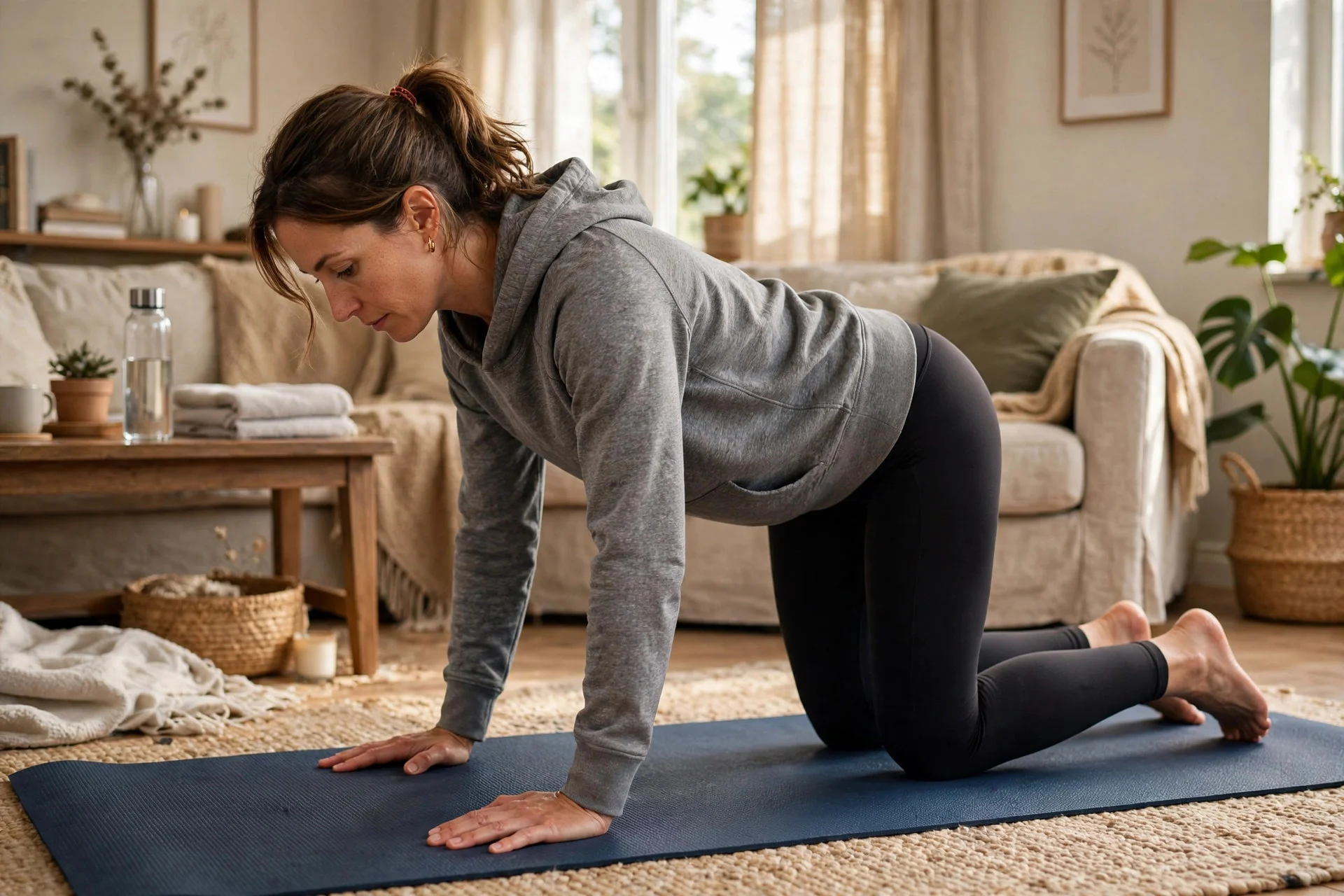
4. Bird Dog
This trains core stability instead of just crunching — teaching your trunk to stay steady while your limbs move.
How to do it:
1. Start on all fours, hands under shoulders, knees under hips
2. Extend your right arm forward and left leg back
3. Keep your back flat — imagine a glass of water on it
4. Hold 2 seconds, return, and switch sides
Make it easier: Extend only the arm or only the leg until your balance improves.
5. Reverse Lunge
Reverse lunges build single-leg strength and balance, and are gentler on the knees than forward lunges.
How to do it:
1. Stand tall with feet together
2. Step one foot back about two feet
3. Lower your back knee toward the floor, keeping your front knee over your ankle
4. Push through your front foot to stand back up
Make it easier: Hold a wall or chair for balance, or shorten your step.
6. Dead Bug
This is one of the safest, most effective beginner core exercises — it teaches you to stabilize your spine while your limbs move.
How to do it:
1. Lie on your back with arms reaching toward the ceiling
2. Lift your legs with knees bent at 90 degrees
3. Slowly lower your right arm overhead and extend your left leg
4. Keep your lower back pressed into the floor
5. Return and switch sides
Make it easier: Move only your arms while keeping your legs still.
7. Standing Knee Raise
This warms up your hip flexors, works your balance, and raises your heart rate.
How to do it:
1. Stand tall with feet hip-width apart
2. Lift your right knee toward hip height, then lower with control and switch legs
3. Swing your opposite arm naturally as you march
Make it easier: Lift the knee only halfway and slow the pace.
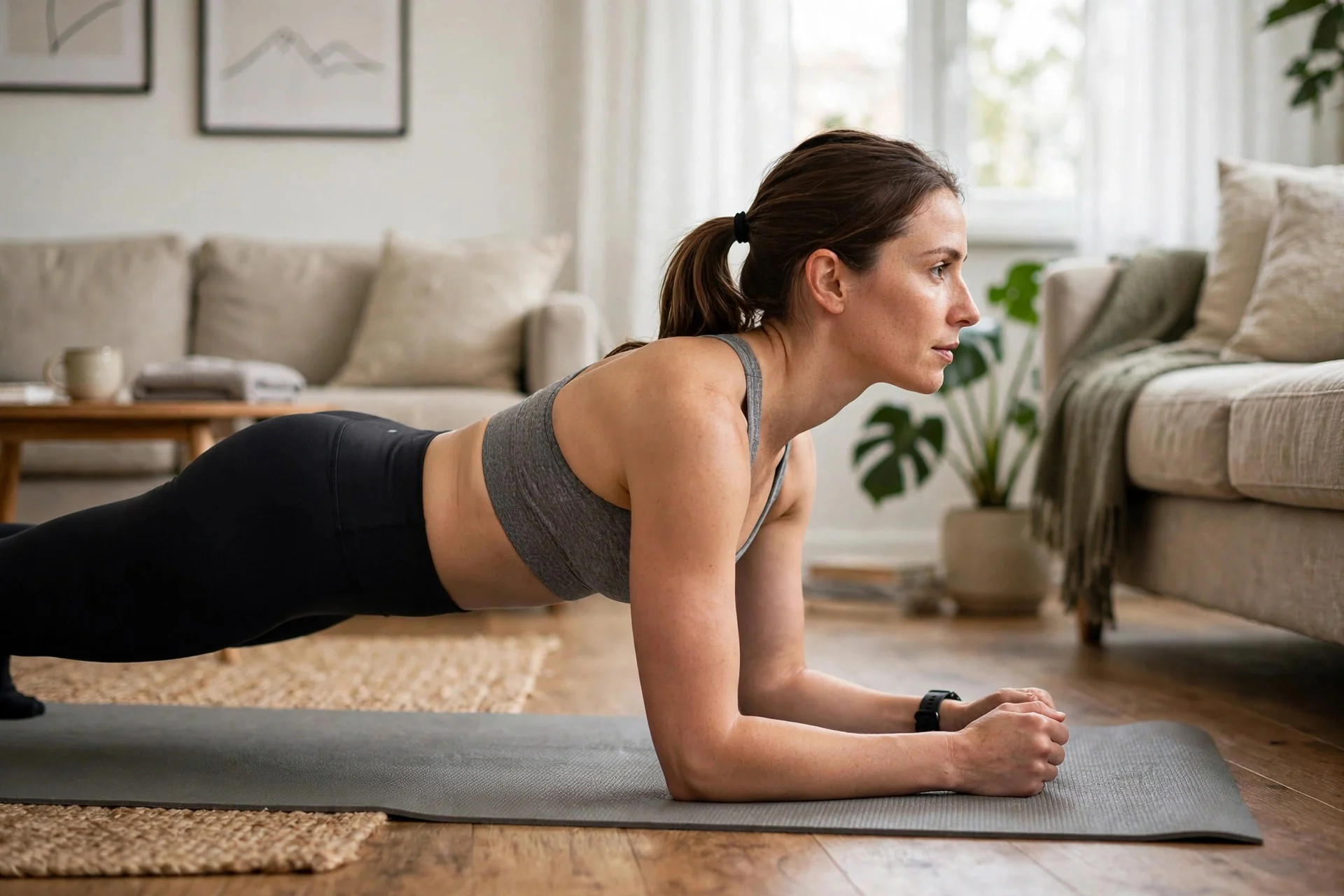
8. Knee Plank
The plank builds total-body stability; starting on your knees lets you learn the position with good form first.
How to do it:
1. Rest on your forearms with knees on the floor
2. Keep your body in a straight line from head to knees
3. Brace your core as if expecting a light tap on the stomach
4. Breathe steadily — never hold your breath
Make it easier: Shorten the hold to 10-15 seconds and build up.
How to Structure Your Workout
A good beginner session has three parts: a 5-minute warm-up (march in place, arm circles, hip circles, half-depth squats), a 20-minute main workout (5-6 of the exercises above, 2 sets each, 45-60 seconds rest between sets), and a 5-minute cool-down (gentle stretches for legs, chest, and shoulders, 20-30 seconds each).
Train 3 days per week with at least one rest day between sessions — your muscles grow during recovery, not during the workout.
Your Starter Plan: Week 1
Do this circuit three times this week (e.g., Monday, Wednesday, Friday):
- Bodyweight Squat — 2 sets of 10
- Incline Push-Up — 2 sets of 8
- Glute Bridge — 2 sets of 12
- Bird Dog — 2 sets of 6 per side
- Reverse Lunge — 2 sets of 8 per leg
- Knee Plank — 2 sets of 20 seconds
Rest 60 seconds between sets. Use the easier version of any move that feels too hard, and write down your numbers each day.
Common Mistakes
Rushing Through Reps
Speed hides weakness. Slow each rep down: 2 seconds down, a brief pause, 1 second up. Fast, sloppy reps skip the muscle work you’re here for.
Letting Form Collapse When Tired
The last few reps are where form matters most — and where it falls apart first. If your back rounds, knees cave in, or hips sag, stop the set. Bad form teaches your body the wrong pattern.
Only Training the “Mirror Muscles”
Push-ups and planks get all the attention while glutes and back get ignored. Include moves for every major area — legs, push, core, balance — or you’ll build imbalances that cause pain later.
Skipping the Warm-Up
Cold muscles are stiff and injury-prone. Five minutes of easy movement before your workout makes every exercise feel smoother and safer. Treat it as part of the workout, not an optional extra.
Comparing Yourself to Others
Someone doing one-arm push-ups started exactly where you are. Chasing advanced moves too soon leads to injury and frustration — master the basics first.
Pro Tips
- Control the lowering phase. The lowering phase of each rep builds the most strength — don’t drop through it.
- Breathe with the movement. Exhale on the effort (pushing up, standing up), inhale on the return.
- Progress one variable at a time: add reps first, then sets, then harder variations.
- Take a monthly form video. Small improvements are invisible day to day but obvious on video.
Frequently Asked Questions
How many bodyweight exercises should a beginner do per workout?
Five to six is the sweet spot — enough to cover all major muscle groups without turning the session into a marathon. Quality beats quantity.
Can bodyweight exercises build muscle?
Yes — especially for beginners. Any challenging, progressive resistance builds muscle, and your body weight is challenging when you’re starting out. When basic moves get easy, progress to harder variations (full push-ups, jump squats, single-leg work) to keep growing.
How long before I see results from bodyweight training?
Expect to feel stronger and more energetic within 2-4 weeks of consistent training. Visible changes in muscle tone usually appear around 6-8 weeks. Three sessions a week matters far more than any single workout.
Should I do cardio too?
Light cardio like brisk walking complements bodyweight training well and aids recovery. Two to three easy walks per week on your rest days is plenty as a beginner.
What if an exercise hurts my joints?
Muscle burn is normal; sharp or pinching pain in a joint is not. Switch to the easier variation or a different exercise for the same muscle group. Persistent pain deserves a professional’s opinion.
Your Next Step
Pick three days this week, run the circuit, and track your numbers. Start today — your body is already the gym.
Related: Beginner Home Workout Routine.
Related: Home Workout Without Equipment.
Related: Best Exercises to Lose Weight Fast.
## Conclusion
Bodyweight training is one of the most underrated ways to build real, functional strength. No gym, no equipment, no excuses: just you, gravity, and a plan. The exercises in this guide work every major muscle group and scale from absolute beginner to advanced athlete.
Calisthenics has built strong, capable bodies for centuries, long before modern gyms existed. Start where you are, progress steadily, and you will be amazed at what your own body weight can do. The best workout is the one you actually do, so press start today.

Fitness enthusiast delivering practical workout routines, nutrition advice, and evidence-based wellness content for all levels.
Pingback: Full Body Workout for Muscle Gain | 3-Day Beginner Plan