
You want to get fitter, but the gym feels like a big leap. Maybe you’re short on time, self-conscious, or just not sure where to start. A beginner home workout routine solves all of that — you exercise in your own space, on your own schedule, with zero equipment.
You don’t need a gym membership or fancy gear to build real strength and fitness. Your body weight is plenty of resistance, and your living room is plenty of space. This guide gives you a simple beginner home workout routine you can repeat consistently. Let’s get moving.
Why a Beginner Home Workout Routine Works
Starting at home removes the biggest barriers to exercise. There’s no commute, no waiting for machines, and no audience. That means you’re far more likely to actually do the workout — and consistency beats intensity every time when you’re starting out.
Learning to squat, push, hinge, and plank with good form builds a foundation that carries into any training you try later. Many who start with a beginner home workout routine keep training at home for years because it simply fits their life.
What You Need to Get Started
Here’s the full equipment list:
- A clear floor space about the size of a yoga mat
- Comfortable clothes and supportive shoes (or bare feet on a mat)
- A chair or sturdy surface for support during balance moves
- A timer or phone for rest intervals
- Water nearby
That’s it. No weights, no bands, no machines.
If you have a health condition, check with a professional before starting a new exercise program.
The Routine: 6 Foundational Moves
This beginner home workout routine uses six moves that cover your whole body. Do it 3 times per week with at least one rest day between sessions.
1. Bodyweight Squats — 10 reps
Stand with feet shoulder-width apart. Push your hips back and bend your knees as if sitting into a chair. Keep your chest up and knees tracking over your toes. Lower until your thighs are roughly parallel to the floor, then stand back up.
- Start with 2 sets of 10 reps
- Rest 60 seconds between sets
- Hold a chair for balance if needed
2. Incline Push-Ups — 8 reps
Place your hands on a sturdy table edge or the seat of a chair. Step your feet back so your body forms a straight line from head to heels. Bend your elbows to lower your chest toward the surface, then push back up.
- Start with 2 sets of 8 reps
- Keep your core tight — don’t let your hips sag
- As you get stronger, use a lower surface
3. Glute Bridges — 12 reps
Lie on your back with knees bent and feet flat on the floor. Press through your heels to lift your hips until your body forms a straight line from shoulders to knees. Squeeze your glutes at the top, then lower slowly.
- Start with 2 sets of 12 reps
- Rest 45 seconds between sets
- Great for building posterior-chain strength
4. Bird Dogs — 6 reps per side
Get on all fours with your back flat. Extend your right arm forward and left leg back at the same time. Hold for 2 seconds, then switch sides. This builds core stability and balance.
- Start with 2 sets of 6 reps per side
- Move slowly — rushing this move ruins the benefit
5. Standing Knee Raises — 10 reps per leg
Stand tall and lift your right knee to hip height, then lower it. Alternate legs in a marching rhythm. Swing your opposite arm naturally. This warms up your hip flexors and gets your heart rate up.
- Start with 2 sets of 10 reps per leg
- Add a light pace once it feels easy
6. Plank — 20 seconds
Rest on your forearms and toes with your body in a straight line. Tighten your belly as if bracing for a gentle punch. Breathe steadily and don’t hold your breath.
- Start with 2 sets of 20 seconds
- Rest 60 seconds between sets
- Drop to your knees if your form breaks
Warm-Up (5 Minutes)
Never skip the warm-up. It raises your body temperature, loosens your joints, and tells your muscles it’s time to work. Do each of these for about one minute:
1. March in place
2. Arm circles (30 seconds forward, 30 seconds backward)
3. Hip circles
4. Bodyweight squats at half depth
5. Shoulder rolls
Week-1 Plan: Your First 7 Days
Consistency matters more than doing everything perfectly. Here’s a simple schedule:
- Day 1: Full routine (all 6 moves, 2 sets each)
- Day 2: Rest or a gentle 20-minute walk
- Day 3: Full routine
- Day 4: Rest or a gentle 20-minute walk
- Day 5: Full routine
- Day 6: Rest
- Day 7: Rest or light stretching
Mark each workout on a calendar. Seeing the streak grow is powerful motivation.
Common Mistakes
Skipping the Warm-Up
Jumping straight into squats or push-ups with cold muscles is asking for strains. Five minutes of easy movement prevents injuries and makes the workout feel better.
Doing Too Much Too Soon
The biggest beginner error is treating day one like a competition. Soreness that leaves you unable to move for three days doesn’t build fitness — it builds dread. Start with the reps listed above, even if they feel easy. You can add more next week.
Ignoring Form for Extra Reps
Ten perfect squats beat twenty sloppy ones. Bad form loads the wrong joints and teaches patterns you’ll have to unlearn later. Use a mirror or film yourself once to check your positions.
Holding Your Breath
Beginners often hold their breath during hard moves, which spikes blood pressure and makes you tire fast. Breathe out on the effort (the push or lift) and breathe in on the return.
Skipping Rest Days
Your muscles rebuild during rest, not during the workout. Training the same moves every day as a beginner leads to burnout and overuse soreness. Three sessions per week is the sweet spot.
Pro Tips
- Track your workouts. Write down sets, reps, and how each move felt. Progress you can see keeps you going.
- Progress gradually. Each week, add 1-2 reps per set or an extra set before you try harder variations.
- Pair workouts with a cue. Do your routine right after morning coffee or before your evening shower. Anchoring it to an existing habit makes it automatic.
- Focus on the mind-muscle link. During glute bridges, actually think about squeezing your glutes. During planks, think about bracing your core. This small habit multiplies your results.
- Sleep and protein matter. You don’t need a strict diet, but enough sleep and protein in your meals helps your body recover and adapt.
Frequently Asked Questions
How long should a beginner home workout be?
About 25-35 minutes including the warm-up. That’s enough to challenge your muscles without draining you. As your fitness improves, you can extend sessions to 40-45 minutes.
How many days per week should I do this routine?
Three days per week with at least one rest day between sessions. Recovery is when you actually get stronger.
Will I build muscle with just bodyweight exercises?
Yes, as a beginner. Your muscles respond to any new, challenging load, and your body weight is plenty of resistance when you’re starting out. Once the listed reps feel easy, progress to harder variations to keep growing.
What if I can’t do a single push-up?
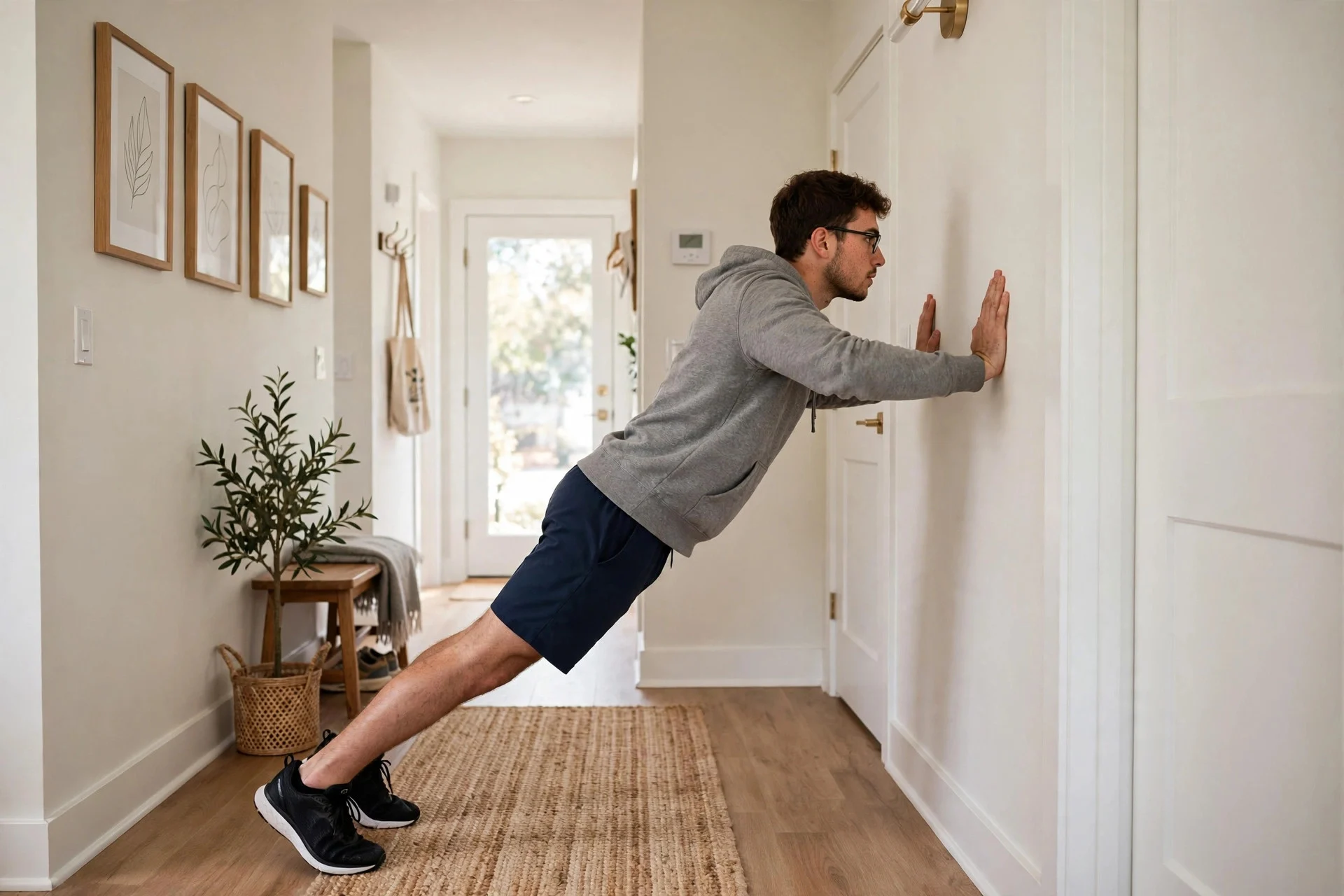
Start with wall push-ups — stand arm’s length from a wall and push against it. When you can do 2 sets of 15 comfortably, move to a table-height surface, then lower surfaces over time. Everyone starts somewhere.
How quickly will I see results?
Most people notice more energy and easier daily movement within 2-3 weeks. Visible strength changes typically show around 6-8 weeks of consistent training. The key word is consistent — three sessions a week beats one heroic session.
Your Next Step
You now have a complete beginner home workout routine, a week-1 plan, and the knowledge to avoid the common pitfalls. The only thing left is to start. Clear a small space, set a timer for 30 minutes, and do Day 1 today — not tomorrow.
Once this routine feels comfortable (usually 3-4 weeks), increase your reps and sets, or try harder variations like regular push-ups and longer planks. Keep showing up, track your progress, and trust the process. Your future self will thank you.
Related: Home Workout Without Equipment.
Related: Bodyweight Exercises for Beginners.
Related: 20 Minute Full Body Workout at Home.
## Conclusion
Starting a workout routine does not require a gym membership, fancy equipment, or hours of free time. What it requires is a simple plan you can repeat. This beginner home workout routine gives you exactly that: a foundation of basic movements, a schedule that respects your recovery, and progressions that keep you moving forward.
Remember that consistency beats intensity when you are starting out. Three short sessions every week will transform your fitness faster than one heroic workout followed by six days on the couch. Show up, do the work, and trust the process. Your future self will thank you.


Health and fitness writer sharing practical training methods, nutrition insights, and science-backed wellness guidance.
Pingback: Bodyweight Exercises for Beginners: A Starter Guide